
Dry Chemical Feed
The dry chemical powder can include a variety of chemical coagulants or flocculants, such as aluminum sulfate, ferric chloride, or calcium hydroxide, among others. The specific chemical used will depend on the characteristics of the water being treated and the specific impurities that need to be removed.
Dry Chemical Feed in Water Quality Applications
Dry chemical feed systems play a key role in improving water quality by accurately delivering solid treatment chemicals used in coagulation, flocculation, pH adjustment, and nutrient control. Whether applied in municipal drinking water treatment or wastewater management, these systems enable precise chemical addition for reliable process performance and regulatory compliance.
What Is Dry Chemical Feed?
Dry chemical feed refers to the process of introducing powdered or granular treatment chemicals—such as alum, lime, soda ash, or polymers—into water streams. The dry product is typically stored in bins, drums, or bulk silos and dispensed through specialized feed systems that control dosage rates based on flow or demand.
How Dry Chemical Feed Systems Work
A dry feeder measures and dispenses a consistent amount of material into a wetting or mixing system, creating a solution or slurry that can be easily integrated into the treatment process. Depending on plant size and automation needs, systems may be manually operated or fully automated, integrating with plant controls for precise chemical management.
Benefits of Dry Chemical Feed
- Storage and Handling Efficiency: Dry products often require less storage space and are easier to transport and store than liquid alternatives.
- Operational Flexibility: Well-suited for both small systems and remote facilities where bulk liquid deliveries may be impractical.
- Reduced Chemical Degradation: Dry materials generally have a longer shelf life and are less prone to performance loss over time.
Small Bag Systems
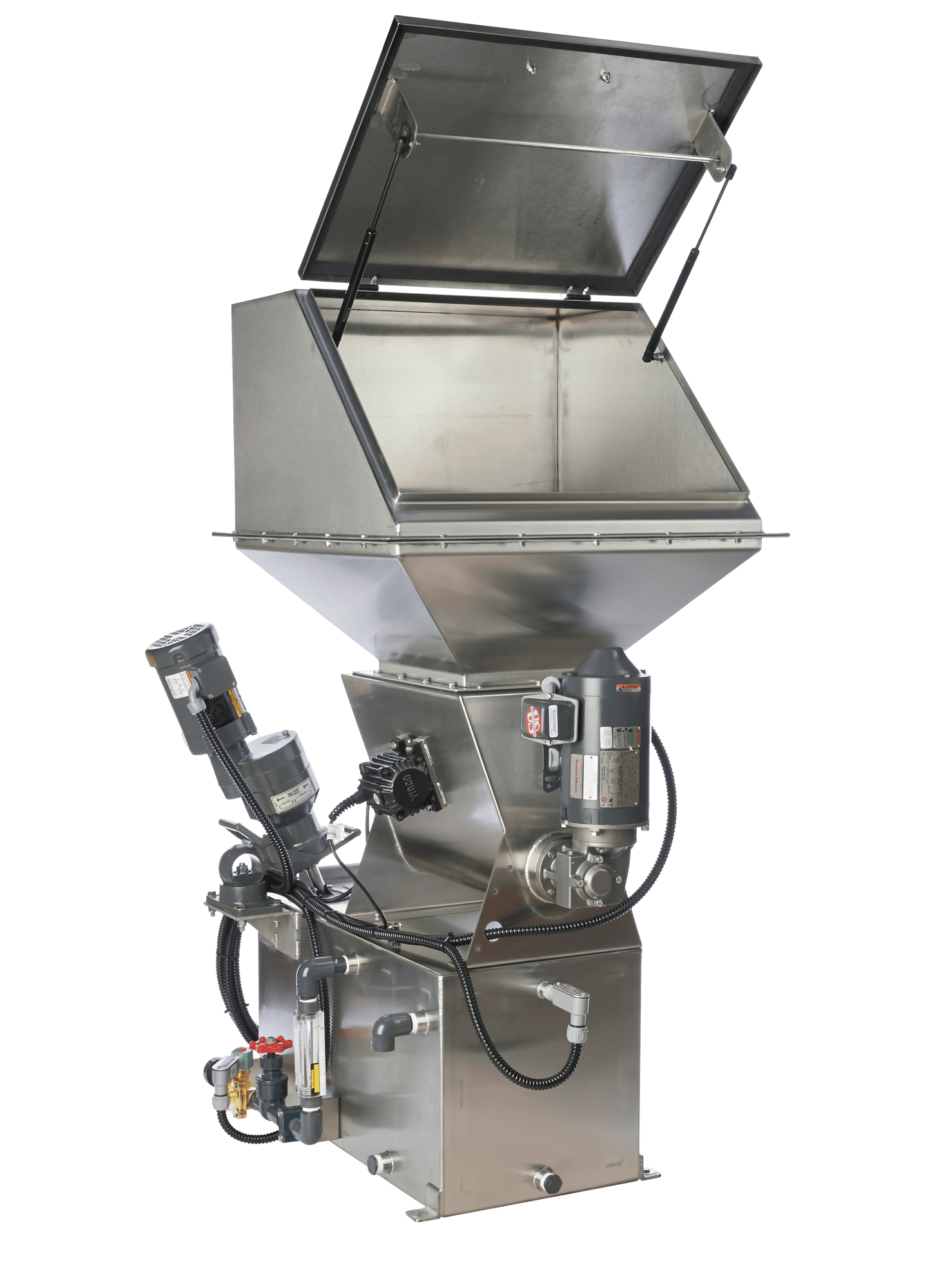
For lower-volume operations or specialty chemical applications, Clean Water 1 small bag feed systems offer simplicity and efficiency.
-
Designed for 50 lb bags or smaller, ideal for compact facilities or trial dosing setups.
-
Ergonomic bag loading stations minimize manual lifting and improve operator safety.
-
Dust-tight enclosures and integrated vents maintain clean air quality during refilling.
-
Optional vibratory feeders or volumetric screws ensure consistent, measured dosing.
These systems provide the same level of accuracy and safety as larger installations—perfect for small municipal or industrial plants.
Bulk Bag Systems (BB Hoppers & Unloaders)
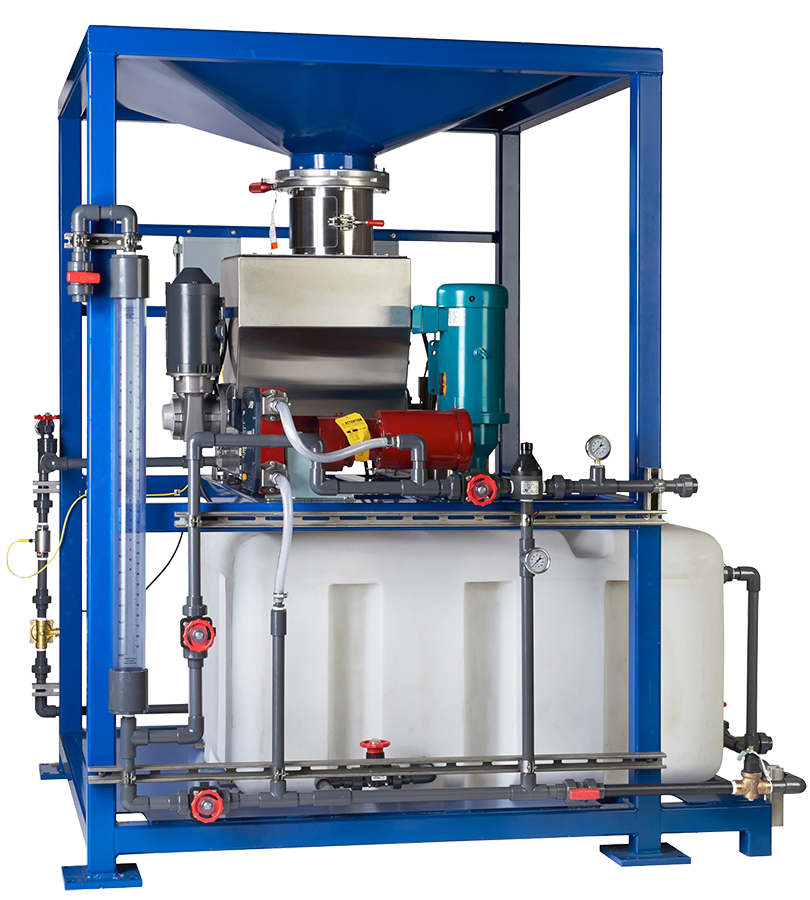
For higher-volume operations, Clean Water 1 bulk bag feed systems provide efficiency, safety, and precision dosing:
-
Sealed bag frames prevent dust release and airborne contaminants.
-
Integrated hoists and bag breakers simplify loading and complete discharge of 2,000 lb bags.
-
Loss-in-weight feeders ensure precise feed rates for demanding water treatment applications.
-
Flexible screw or pneumatic conveyors deliver materials to wetting cones, mixers, or day bins.
-
Dust collection options maintain a cleaner, safer work area.
Modular by design, these systems can scale from small municipal plants to large industrial installations, and integrate easily with SCADA and automated reporting systems.
Silo Systems
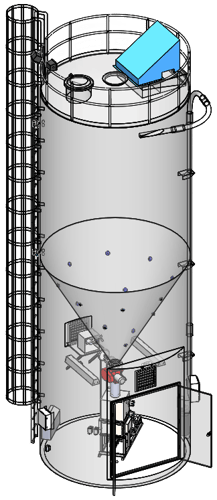
When continuous or large-scale dry chemical storage is needed, Clean Water 1 silo systems provide the ultimate solution for volume efficiency and automation.
-
High-capacity storage silos handle bulk deliveries directly from tanker trucks.
-
Live-bottom or vibration-assisted discharge ensures reliable flow of dry product.
-
Loss-in-weight or gravimetric feed controls maintain accurate dosing.
-
Level monitoring sensors and dust control systems enhance operational safety.
-
Designed for year-round outdoor installation, with options for moisture control, temperature protection, and material compatibility coatings.
These silos integrate seamlessly with Clean Water 1 feeders and conveyance systems to form fully automated dry chemical handling solutions.

Design Considerations
When a selecting a dry chemical feed solution, engineers and operators should evaluate:
-
Chemical type and solubility: Determines hopper and wetting requirements.
-
Feed accuracy: Gravimetric vs. volumetric control for tight tolerance applications.
-
Material compatibility: Prevents corrosion or abrasion.
-
Storage conditions: Avoids moisture absorption and clumping.
-
Safety features: Dust collection, interlocks, and shutdown protocols.
-
Automation integration: SCADA and remote data feedback for continuous monitoring.
-
Footprint and capacity: Determining whether a small bag, bulk bag, or silo system is most cost effective for the application.
Maintenance & Operator Support
Routine inspection and maintenance keep systems operating at peak efficiency:
-
Verify feed calibration and hopper levels regularly.
-
Clean wetting cones and screws to prevent buildup.
-
Replace seals and belts as needed to a void leaks.
-
Keep safety equipment and PPE readily available.
Cleanwater1 provides complete operator training and field service support ensuring your feed system delivers consistent performance with minimal downtime.
Applications
-
Municipal drinking water (coagulation and turbidity control).
-
Wastewater conditioning and sludge dewatering (polymer activation).
-
Industrial process water (pH adjustment and scaling control).
-
Nutrient and odor management in collections systems.
-
Specialty chemical applications requiring small bag deliver or silo storage.

Let's get the conversation started
Connect with Cleanwater1 to discuss your site’s chemical feed challenges and explore a right-sized solution—from small bag systems to full-scale silo storage.
Dry Chemical Processing FAQ
When dealing with dry chemicals like lime, soda ash, and Powdered Activated Carbon (PAC), the equipment must handle unique challenges such as dust control, chemical "bridging," and abrasive wear.
Here is a FAQ covering the essential equipment and processes used in water treatment plants.
A typical system includes a storage silo or hopper, a bin activator or vibrator (to prevent clogging), a volumetric or gravimetric feeder, a wetting cone (eductor) or slurry tank, and a transfer pump to move the solution to the injection point.
Volumetric Feeders: Dispense chemical based on a constant speed/volume (e.g., rotations of a screw). They are simpler and cheaper but less precise if the chemical density changes.
Gravimetric Feeders: Weigh the material as it is fed. They adjust speed automatically to ensure a precise mass-per-hour rate, which is critical for expensive chemicals like PAC. These systems use load cells.
Dry chemicals are prone to bridging (forming an arch over the outlet) or ratholing (a small hole forms in the center while the sides stay packed). Bin activators and vibrators use vibration or mechanical agitation to break these bonds and ensure a steady flow into the feeder.
To protect operators and equipment, systems use dust collectors or baghouses mounted on top of silos or hoppers. These use vacuum pressure and fabric filters to capture airborne particles during pneumatic unloading or filling.
Quicklime (CaO) must be converted into hydrated lime (Ca(OH)2) before it can be used. A lime slaker mixes the dry quicklime with water in a controlled exothermic reaction to create a "milk of lime" slurry, which is used for the process.
PAC is extremely fine, highly abrasive, and messy. It is also potentially explosive in high concentrations. Equipment must be dust-tight, often requiring explosion-proof motors.
A wetting cone (coupled with an eductor) uses a high-velocity water spray to create a vacuum that pulls dry chemical into the stream. This ensures the powder is instantly "wetted" and mixed, preventing clumps (known as "fish-eyes") from forming.
Soda ash is typically more free-flowing and more soluble in water than lime. While it still requires dust and humidity control, it can be mixed directly into a solution tank using a standard agitator. Water temperature is important and affects the solubility in water.
The powdered lime used is the same, but a typical hydrated lime is made down into a slurry concentration of 5% - 10% while high-density lime is made down into a slurry concentration of 35% - 40%. The higher density slurry uses a special mixing system coupled with gravimetric feeding and results in a slurry that is more stable.
The feed rate is usually "paced" to the plant's raw water flow. A flow meter sends a signal (4-20mA) to the feeder’s Variable Frequency Drive (VFD), which speeds up or slows down the motor to maintain the correct dosage (mg/L) regardless of how much water is being treated.
Additional Resources

Learn At Your Pace
By subscribing to our learning track, you will receive emails featuring videos, webinar invites, informative articles and more.

View Our Online Library
Featuring brochures, case studies, data sheets and more. Filter by product category, brand, location, use case or document type.

Connect With Us
Contact a member of our team using our online form, by email us or give us a call. We look forward to speaking with you.